
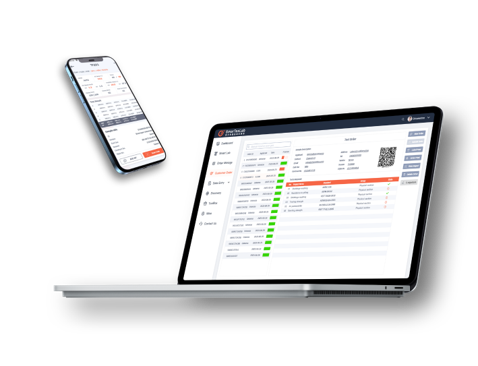
Digital Textile Lab là gì? Tương lai của Chuyển đổi số phòng Lab Dệt May trong 5 năm tới
Digital Textile Lab – The future of laboratory Digital Transformation in the next 5 years
For decades, textile laboratories have invested heavily in testing equipment, environmental control systems, and technical capabilities to meet the quality requirements of brands and manufacturers.
Today, however, having advanced testing equipment alone is no longer enough.
Global brands are placing increasing demands on:
- Data transparency
- Traceability
- Faster turnaround times
- Consistent results across laboratories
- Integration of laboratory data into digital supply chains
These evolving requirements are driving a new transformation across the textile industry:
The transition from traditional laboratories to Digital Textile Labs.
What Is a Digital Textile Lab?
A Digital Textile Lab is a modern laboratory environment where:
- Testing equipment is digitally connected
- Data is captured automatically
- Results are stored centrally
- Processes are standardized
- Information is easily traceable and accessible
Instead of relying on:
- Paper records
- Isolated spreadsheets
- Manual data entry
A Digital Textile Lab creates an integrated ecosystem connecting:
Testing Equipment → Data → Software → Laboratory Personnel → Quality Management Systems
The objective is not simply to digitize information, but to improve efficiency, reliability, transparency, and decision-making across laboratory operations.
Common Challenges Facing Traditional Laboratories
1. Data Is Stored in Multiple Locations
Test results are often scattered across:
- Excel files
- Emails
- Personal computers
- Printed reports
This makes retrieving historical information time-consuming and inefficient.
2. Manual Data Entry
Many laboratories still rely on:
- Handwritten records
- Spreadsheet-based calculations
- Manual report preparation
These processes increase the risk of human error and reduce overall productivity.
3. Limited Traceability
When audits, customer complaints, or investigations occur, laboratories may struggle to quickly retrieve:
- Test results
- Environmental conditions
- Equipment records
- Operator information
Without proper traceability, valuable time can be lost searching for critical information.
4. Difficulty Scaling Operations
As testing volumes increase, manual workflows often become bottlenecks that limit growth and efficiency.
Technologies Reshaping Textile Testing
Smart Testing Equipment
The latest generation of testing instruments does much more than perform tests.
Modern systems can:
- Capture data automatically
- Store electronic records
- Connect with management platforms
- Reduce reliance on manual processes
Centralized Data Management
A centralized laboratory data environment enables:
- Faster data retrieval
- Better visibility of testing history
- Improved transparency
- More effective decision-making
Connected Systems
The future laboratory is built around connectivity.
Testing equipment, operators, reports, and quality systems are increasingly integrated into a seamless information flow.
Artificial Intelligence and Automation
AI and automation technologies are beginning to support laboratories by:
- Analyzing large datasets
- Detecting anomalies
- Monitoring trends
- Optimizing workflows
- Improving operational efficiency
How Textile Laboratories Will Evolve Over the Next Five Years
Based on trends emerging across Europe, China, and global supply chains, several major developments are expected.
Data Will Become as Important as Equipment
The value of a laboratory will increasingly be measured not only by its testing capabilities, but also by its ability to manage, protect, and leverage data.
Automation Will Become Standard Practice
Routine activities will gradually be replaced by:
- Smart instruments
- Automated workflows
- Integrated management systems
allowing laboratory professionals to focus on higher-value activities.
Traceability Will Become Mandatory
As initiatives such as: ESG, Sustainability Reporting, Digital Product Passport (DPP), Supply Chain Transparency,… continue to expand, reliable and traceable laboratory data will become essential.
Smart Laboratories Will Create Competitive Advantage
Organizations that can operate laboratories more efficiently, transparently, and reliably will gain stronger positions within global supply chains.
How Companies Can Start Today
The journey toward a Digital Textile Lab does not necessarily require a major investment from day one.
Companies can begin with practical steps:
- Assess Current Laboratory Operations – Identify bottlenecks related to: Data, Processes, Equipment, People
- Digitize Laboratory Information – Reduce dependence on paper records and disconnected spreadsheets.
- Invest in Connected Equipment – Data connectivity should become a key consideration when selecting new testing systems.
- Develop a Smart Laboratory Roadmap – Rather than implementing isolated projects, organizations should establish a long-term strategy for laboratory digitalization.
TAV’s Vision for Digital Textile Laboratories
As a pioneer in Smart Testing Technology, TAV is working alongside global partners to help textile manufacturers build the next generation of laboratories.
Beyond meeting international testing standards, our solutions are designed to:
- Digitalize laboratory data
- Reduce manual operations
- Improve equipment connectivity
- Enhance traceability
- Increase laboratory efficiency
These capabilities form the foundation of a Digital Textile Lab.
Through Amitec and the broader TAV Group ecosystem, textile manufacturers in Vietnam can gain early access to the technologies that are shaping the future of textile testing.
Conclusion
Digital Textile Labs are no longer a vision of the distant future.
They are becoming an increasingly important requirement for organizations seeking to improve competitiveness, strengthen data reliability, and meet the growing expectations of global brands and supply chains.
Companies that begin preparing today will be better positioned to build laboratories that are more efficient, transparent, and future-ready.
The future of textile testing is not only about generating results.
It is about creating trusted data that drives quality, compliance, sustainability, and business performance.
Sign up for advice
- Hotline0938 078 338
- emailinfo@thachanhvang.com


